Hair fall: telling ordinary shedding apart from actual loss
A hundred hairs a day is normal. What matters is not how many come out but whether the hair growing back is thinner than what it replaced.
Not yet reviewed by a dermatologist. General information only.
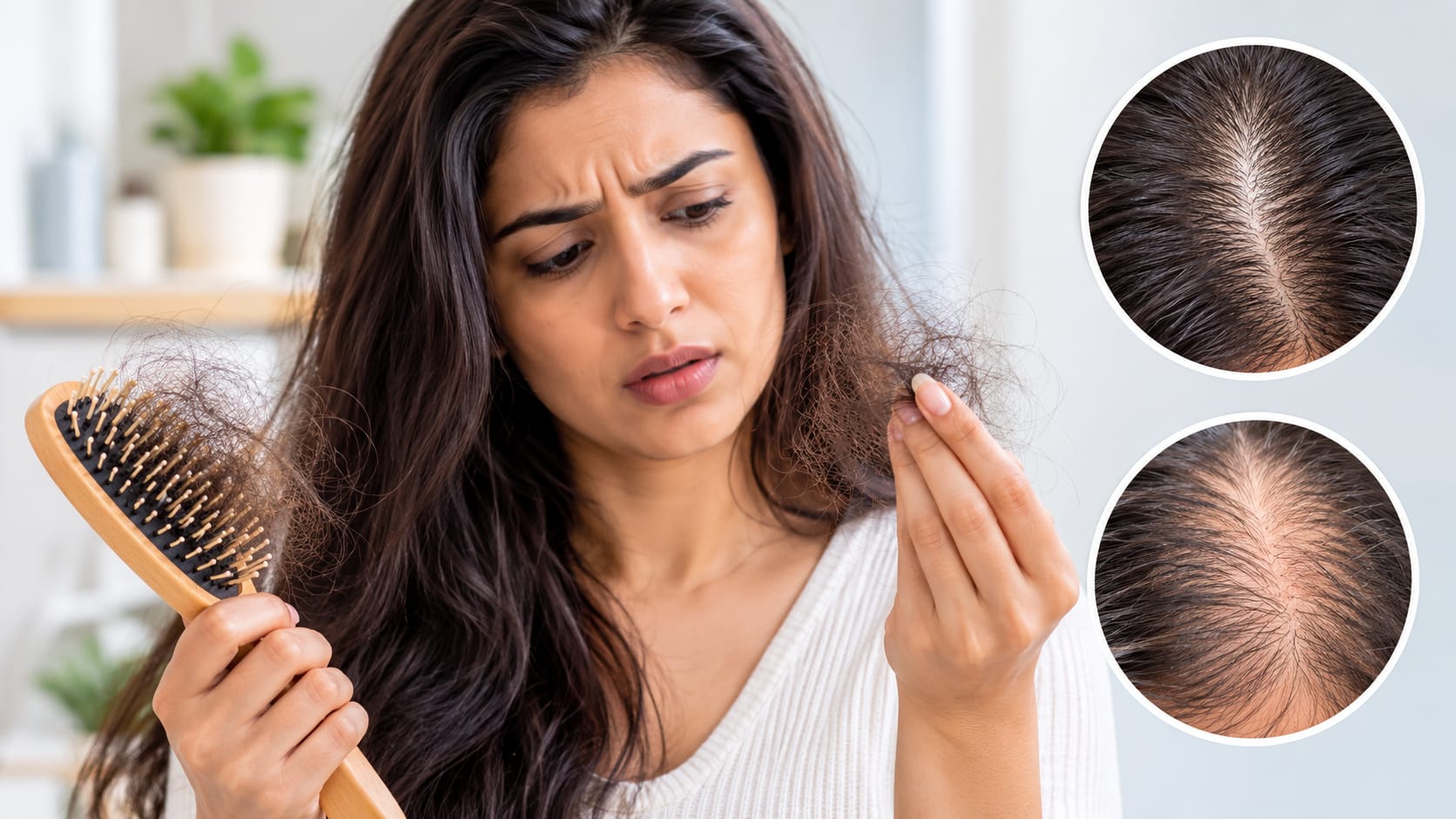
Key Takeaways
- Shedding and loss are different: one is temporary and diffuse, the other gradual and patterned.
- Losing some hair daily is normal; a change in the pattern is the signal worth acting on.
- Telogen effluvium usually follows an event by two to three months and recovers.
- Most widely sold hair supplements have no evidence behind them.
Almost everyone who worries about hair fall is counting the wrong thing. Hair in the drain is a poor signal — it is visible, alarming, and mostly normal. The signal that matters is density and calibre: is there less hair across the scalp, and is the hair that regrows thinner than what fell out?
The normal number
Each follicle cycles independently through growth (anagen, two to seven years), transition (catagen), and rest (telogen, about three months), after which the hair is shed and a new one starts. At any moment roughly 10% of your follicles are resting.
That works out to 50 to 100 hairs a day. Wash day looks catastrophic because you are seeing several days' worth at once — that is collection, not loss.
Telogen effluvium: sudden, diffuse, reversible
An abrupt increase — handfuls, visible thinning across the whole scalp, no distinct bald patches — usually means a large share of follicles were pushed into rest at once.
The characteristic feature is delay: the trigger is two to three months before the shedding starts. People look for a cause in the week it began and find nothing.
Common triggers: a high fever or infection, childbirth, surgery, significant weight loss or crash dieting, severe stress, iron deficiency, thyroid disorders, and starting or stopping certain medications.
It is self-limiting. Once the trigger is resolved, regrowth follows over six to nine months. No shampoo accelerates this.
Androgenetic alopecia: gradual, patterned, progressive
This is the common, genetically driven pattern loss and it behaves differently. It is slow, follows a pattern, and critically, it involves miniaturisation — follicles produce progressively finer, shorter, lighter hairs until they stop.
In men: receding temples, thinning at the crown. In women: widening of the central parting with the frontal hairline usually preserved.
Miniaturisation is the distinguishing sign. Diffuse shedding where the regrowth is the same thickness is effluvium. Thinning where new hairs are visibly finer is pattern loss.
It is progressive. Treatment maintains what is there and partially reverses recent loss; it does not revive follicles that closed years ago. Starting earlier matters more than choosing the perfect product.
When to worry more, not less
Some patterns need prompt attention rather than patience:
- Distinct smooth round bald patches — possibly alopecia areata
- Scaling, redness, pustules or persistent itch — an inflammatory or fungal scalp condition
- Pain, burning, or loss of visible follicle openings — scarring alopecia, where follicles are permanently destroyed and time genuinely matters
- Hair loss with irregular periods, excess facial hair, or acne — worth a hormonal workup
- Patchy loss with broken hairs in children — tinea capitis needs oral treatment, not a topical
What is worth testing
If shedding is diffuse and persistent: ferritin, complete blood count, thyroid function, and vitamin D. Iron deficiency is a frequent and correctable contributor, particularly in menstruating women.
Supplementing what you are not deficient in does nothing. Excess selenium and excess vitamin A both cause hair loss.
What does not work
Oiling does not reduce hair fall. It can improve manageability and reduce breakage, which is a different thing from loss at the root — and heavy oiling along the hairline contributes to acne.
Shampoo cannot address follicle biology, because it does not stay on the scalp long enough and does not target the right mechanism. Switching shampoos because of hair fall is almost always a wasted month.
See a dermatologist when
There are bald patches, scalp symptoms, visible scalp through the parting, hair loss alongside hormonal symptoms, shedding beyond six months, or any suspicion of scarring. For scarring alopecias in particular, early treatment is the difference between stabilising and losing follicles permanently.
This article is general information, not a diagnosis or a treatment plan. Skin and hair conditions that look alike can need very different treatment. If something is painful, spreading, changing or not responding, see a qualified dermatologist in person.